

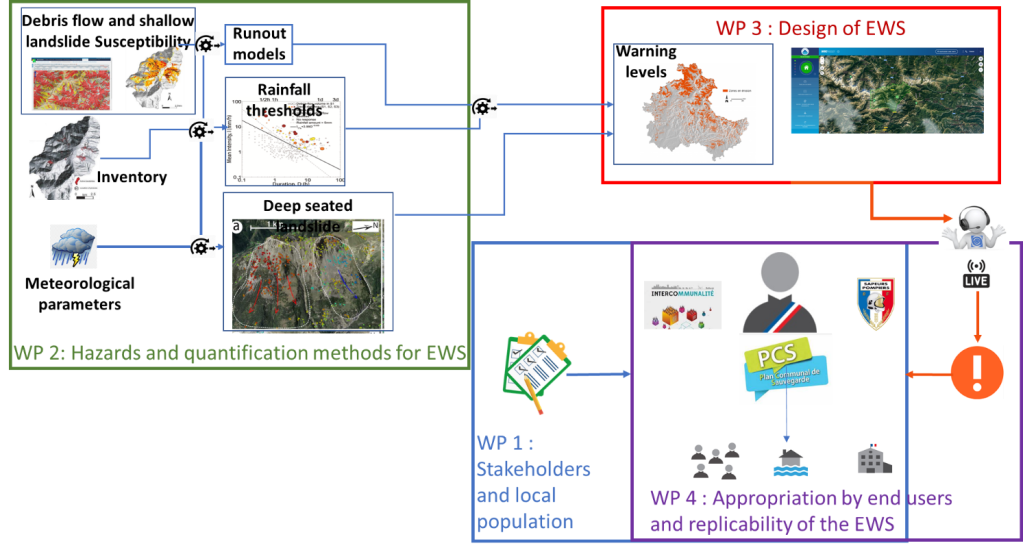
The project will focus its analyses in the Southern Alps. The work program and the associated research activities is organized in 4 Work Packages:
- WP1 dedicated to stakeholders and local population;
- WP2: Hazards and quantification methods for an early warning design ;
- WP3: Design of early warning system, validation and implementation ;
- WP4: Appropriation by end users and replicability of the EWS.
WorkPackage 1 : Stakeholders and local population (LIEU)
This Wp will address, through demonstrator sites, the different needs and acceptability of stakeholdrs regarding landslides and debris flows EWS. Sociological surveys will be conducted among stakeholders and local population to gather qualitative data regarding risk perception, local memories of risk, pre-existing locl ways of doing regarding risk prevention and crisis management. Proposals from stakeholders and population will be shared with our research team included into the EWS tool.
WorkPackage 2 : Hazards and quantification methods for an early warning design (INRAE)
This WP will address, through studies sites, the analysis and the quantification of landslides and debris flows hazards for designing EWS. The different components of this analysis will be addressed : improvement of meteorological data, rainfall thresholds definition, shallow landslide and debris flow susceptibility mapping, deep landslide kinematic analysis, and run out models.
WorkPackage 3 : Design of early warning system (BRGM)
This WP aims at combining thresholds rainfall to a susceptibility map, permitting to obtain a spatiotemporal forecasting system. Based on this approach, the warning levels will be defined, at the adequate spatial resolution, with considering spatial variability. then the performance of rainfall thresolds and EWS will be assessed. the implementation of EWS will finally be realised on the platforms, based on dynamic landslide & debris flow vigilance map.
WorkPackage 4 : Appropriation by end users and replicability of the EWS (PREDICT)
The objective of this WP is to transfer the management of hazard warning system to end users. For that, the warning messages will be tailored to end users, permitting to send the appropriate information to end users. Then the user committee will test in real conditions the contribution of the real-time decision support chain, and will also benefit from the training necessary for the use and interpretation of the data that will be disseminated in real time. Moreover, these training will be completed with natural risk information, ensuring an adequate and homogeneous behavior of the stakeholders during a crisis. The replicability of the system, with a guideline that defines the global methodology, constitutes another issue to be achieved.
 vigimont.fr